
CJC-1295 and Ipamorelin: Should You Mix Them?
Should you mix CJC-1295 and Ipamorelin in the same syringe? You can — but whether you should comes down to one detail almost every guide on the subject gets wrong. This piece works through where the reasoning behind combining the two is sound, where it is extrapolation rather than evidence, and why the two are best supplied as separate vials.
CJC-1295 and Ipamorelin: Should you mix in the same syringe?
Yes — combined at the point of use, this is sound. Both peptides are reconstituted in bacteriostatic water at a similar pH, and because CJC-1295 (No DAC) acts on the GHRH receptor while Ipamorelin acts on the ghrelin/GHS receptor, there is no competition between them when they are administered together. They can be drawn into one syringe immediately before use, or into two separate syringes given at a similar time — mechanically, the two are equivalent.
The distinction that actually matters is not syringe versus syringe, but combining at the point of use versus storing as a blend — and that is where most of the confusion in this niche sits. The rest of this article is really about the second question.
Why is CJC-1295 sold as No-DAC for this pairing?
This is the part most sources get wrong, so it is worth being precise.
“CJC-1295” refers to two different compounds. The DAC version (Drug Affinity Complex) binds to albumin in the blood and stays active for roughly 6–8 days. The No-DAC version — the same core peptide, also called Modified GRF 1-29 — lacks that modification and clears in about 30 minutes.3 These are mechanistically distinct formulations, and the pharmacokinetic data for one does not transfer to the other.1 (For the full comparison, see the CJC-1295 (No DAC) page.)
That 30-minute figure is not a weakness — it is the reason No-DAC is the form paired with Ipamorelin. Ipamorelin produces a discrete growth-hormone pulse; in human pharmacokinetic work its half-life is around two hours, with GH peaking near 40 minutes and returning to baseline within a few hours.2 To stack usefully with that pulse, the GHRH side needs to pulse too. The short-acting No-DAC form does; the long-acting DAC form, which delivers a continuous multi-day signal, does not.
Which of the two forms to use is one of the most-debated questions around this pairing, and the common recommendation — No-DAC — happens to line up with the pharmacology. When articles quote CJC-1295’s “6–8 day” duration or its large sustained IGF-1 elevation, they are describing the DAC compound, a different molecule from the No-DAC form sold for stacking. Applying one’s data to the other is one of the most persistent misattributions in the field.
Can you store CJC-1295 and Ipamorelin mixed in one vial?
No. There is no published stability data for the two peptides held together in a single solution over time. Combining them at the point of use is one thing; storing them pre-mixed is another, and the second has no research behind it.
This is the direct reason the two are best supplied as two separate 5mg vials rather than a single pre-blended one. Separate vials mean each peptide sits in its own solution, stored under known conditions, and the two are only ever brought together at the moment of use. A pre-mixed blend trades that away for the convenience of a single vial — and does so on the basis of stability data that does not exist. It is worth noting that much of the community discussion assumes a single pre-mixed vial as the default starting point; that assumption is exactly the thing there is no evidence for.
Should you take them together, or at separate times?
Together is what makes the pairing worthwhile — and understanding why means understanding how growth hormone is released in the first place.
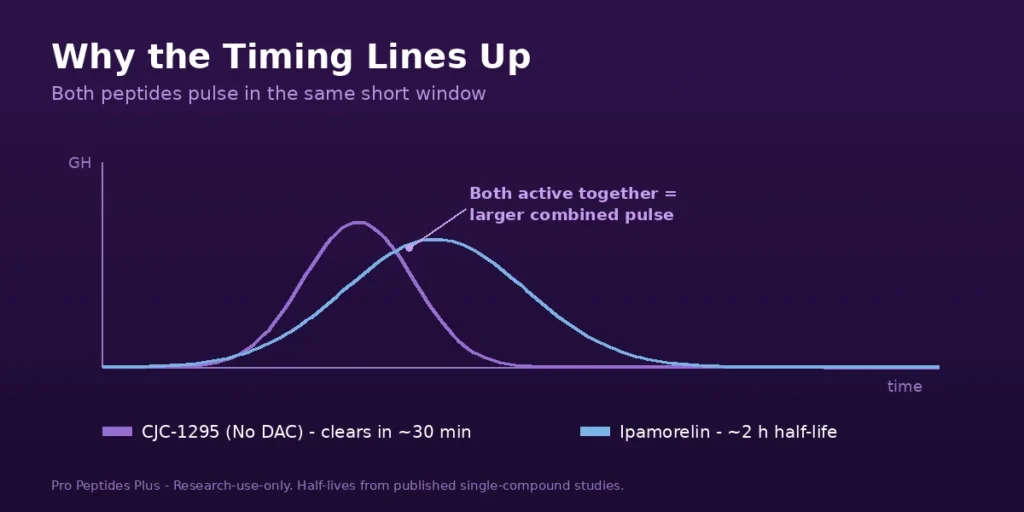
The body does not release GH in a steady stream. It releases it in pulses, several times a day, with the largest pulse occurring during deep sleep. This is why growth hormone is often described as following the body’s natural rhythm rather than a constant level. Secretagogues like these two work by amplifying that pulsatile pattern rather than overriding it — which is also why, in research settings, GH secretagogues have typically been administered to coincide with the natural nocturnal pulse.
Against that backdrop, the logic of pairing a GHRH analogue with a ghrelin-receptor agonist is a documented one: administered together, the two produce a growth-hormone release larger than the sum of either alone.4 The mechanisms are independent — one primes the pituitary to synthesise and release GH, the other amplifies that release and suppresses somatostatin, the body’s natural brake on GH. Acting in the same window, they press the accelerator and release the brake at once.
That overlap only happens if both compounds are active together. With a 30-minute half-life on the CJC-1295 (No DAC) side, spacing the two several hours apart means the GHRH signal has largely cleared before the ghrelin signal is working — and the supra-additive effect is what you lose. This is precisely why the short-acting form is the one used: it is short enough to be timed against Ipamorelin’s pulse.
Do they need to be injected at the same time to work at all?
No. Each compound raises growth hormone on its own, through its own receptor — neither depends on the other to have an effect. The case for co-administration is not that they fail apart; it is that together they do more than they do separately. The closer the two are in timing, the more the receptor signals overlap, and the larger the combined release. Separating them does not switch the effect off — it forfeits the synergy that is the reason for pairing them in the first place.
Has the CJC-1295 and Ipamorelin combination actually been studied together?
Not directly. There is no published human trial of CJC-1295 (No DAC) and Ipamorelin administered as a pair. The evidence usually cited for the stack is of two kinds, and it is worth separating them.
The first is compound-specific, and looking at how those studies were actually run is instructive. Ipamorelin’s human pharmacokinetics were characterised in a dose-escalation trial in which healthy male volunteers received it as an intravenous infusion — not the subcutaneous, before-bed routine described in most popular protocols.2 CJC-1295’s best-known human data — the large, sustained GH and IGF-1 elevation — comes from a 2006 dose-escalation trial that used the DAC form.1 Both are real studies; neither tested the pairing, and one tested a different version of the compound. The gap between how these compounds were studied and how they are commonly discussed is itself part of the story.
The second kind of evidence is class-level. The finding that a GHRH analogue and a growth-hormone-releasing peptide combine to produce a supra-additive GH pulse goes back to work from around 1990 onward, and it is robust4 — but it is a finding about the two classes, demonstrated with various specific peptides, not a study of this exact pair.
Everything beyond that is anecdote. The combination is heavily discussed in communities like Reddit’s r/Peptides, but personal reports — however numerous — are not controlled data. They describe what people believe they experienced, not what the compounds reliably do. Treating a popular thread as evidence is how a lot of the misinformation in this space gets started. So the synergy argument is mechanistic extrapolation supported by class-level research: stronger than the reasoning behind many peptide stacks, but still not a trial of these two compounds together, and it is honest to say so.
Does the stack shut down your natural GH production?
No. This is a common concern, borrowed from how suppressive hormones like exogenous testosterone behave. Secretagogues work differently. They stimulate the pituitary to release your own growth hormone — they amplify an existing signal rather than replacing it. When they are stopped, production returns to its baseline rather than crashing. That is a meaningful distinction from synthetic HGH, which supplies the hormone directly.
It is not a free pass — continuous, non-pulsatile overstimulation is the theoretical concern behind why the short-acting, pulse-mimicking forms are generally preferred — but the “it will shut me down like a steroid” worry is not how this class of compound works.
Does Ipamorelin raise cortisol or prolactin?
No — and its selectivity is why it is the ghrelin-receptor partner of choice. Earlier growth-hormone-releasing peptides tended to raise cortisol and prolactin alongside GH. Ipamorelin was developed to release growth hormone without that off-target effect.5 (The selectivity data is covered in full on the Ipamorelin page.)
Regulatory and sporting status
Both compounds are prohibited by the World Anti-Doping Agency under the peptide-hormones and growth-factors category, in and out of competition. Neither CJC-1295 nor Ipamorelin is approved by the FDA for any indication; Ipamorelin reached Phase II trials for an unrelated gastrointestinal condition and was discontinued after the trial did not meet its endpoint. Both remain investigational compounds sold strictly for research use only.
Weighing it up: the case for and against combining them
Laid out plainly, so you can judge it rather than be sold on it:
What supports combining the two: the mechanisms are independent and complementary, so together they produce a larger GH pulse than either alone; their short half-lives can be matched so both act in the same window; the No-DAC pulse mirrors the body’s natural release pattern; and because they are secretagogues, they amplify endogenous production rather than suppressing it.
What qualifies it: no published study has tested this specific pair together; there is no stability data for storing them pre-mixed; the strongest evidence is class-level extrapolation rather than direct; the most-quoted CJC-1295 figures actually describe the DAC compound, not the No-DAC form used here; and both are WADA-prohibited, non-FDA-approved, research-use-only substances.
Frequently asked questions
Should you mix CJC-1295 and Ipamorelin in the same syringe?
You can. Both are reconstituted in bacteriostatic water and act on different receptors, so they can be drawn into one syringe immediately before use, or into two syringes given at a similar time. What has no supporting data is storing them pre-mixed in a single vial.
Why is CJC-1295 sold as No-DAC for this stack?
Because only the short-acting No-DAC form (Modified GRF 1-29, roughly a 30-minute half-life) can pulse in time with Ipamorelin. The long-acting DAC form delivers a continuous multi-day signal and cannot be timed against a pulse.
Can they be stored mixed in one vial?
No. There is no published stability data for the two held together in solution over time. This is why they are best supplied as two separate vials and combined only at the point of use.
Should they be taken together or separately?
Together, if the goal is the synergy. Administered in the same window they produce a larger growth-hormone release than either alone; spacing them apart reduces the combination to two smaller separate responses.
Has the combination been studied in humans?
Not as a pair. The supporting evidence is either compound-specific or class-level (a GHRH analogue plus a growth-hormone-releasing peptide). No published trial has tested these two specific compounds administered together.
Does the stack suppress natural growth hormone production?
No. Both are secretagogues, meaning they stimulate the pituitary to release your own growth hormone rather than replacing it. Production returns to baseline after use rather than being suppressed.
Where this leaves the stack
CJC-1295 (No DAC) and Ipamorelin are the most-discussed growth-hormone peptide pairing, and the logic behind combining them is coherent: two independent receptors, one priming release and the other amplifying it, timed to act together against the body’s natural GH pulse. That is a real rationale — and it is also why the short-acting No-DAC form, not the DAC version whose data everyone quotes, is the one that belongs in the pairing.
On the practical question, the evidence points one way: combine at the point of use if at all — one syringe or two, given close together — and keep them as separate vials in storage, where there is no stability data to justify a pre-mixed blend. Anyone presenting the combination as clinically proven is going beyond the evidence; anyone quoting CJC-1295’s multi-day duration for a No-DAC stack is quoting the wrong compound. Both are worth knowing before you read anything else on the subject.
References
- Teichman SL, Neale A, Lawrence B, Gagnon C, Castaigne JP, Frohman LA. Prolonged stimulation of growth hormone (GH) and insulin-like growth factor I secretion by CJC-1295, a long-acting analog of GH-releasing hormone, in healthy adults. J Clin Endocrinol Metab. 2006;91(3):799–805. PMID: 16352683. View on PubMed
- Gobburu JV, Agersø H, Jusko WJ, Ynddal L. Pharmacokinetic-pharmacodynamic modeling of ipamorelin, a growth hormone releasing peptide, in human volunteers. Pharm Res. 1999;16(9):1412–1416. PMID: 10496658. View on PubMed
- Jetté L, Léger R, Thibaudeau K, et al. Human growth hormone-releasing factor (hGRF)1-29-albumin bioconjugates activate the GRF receptor on the anterior pituitary in rats: identification of CJC-1295 as a long-lasting GRF analog. Endocrinology. 2005;146(7):3052–3058. PMID: 15817669. View on PubMed
- Bowers CY. Growth hormone-releasing peptide (GHRP). Cell Mol Life Sci. 1998;54(12):1316–1329. PMID: 9862719. View on PubMed
- Raun K, Hansen BS, Johansen NL, et al. Ipamorelin, the first selective growth hormone secretagogue. Eur J Endocrinol. 1998;139(5):552–561. PMID: 9849822. View on PubMed
- Note: no published peer-reviewed study has tested CJC-1295 (No DAC) and Ipamorelin administered together, nor the stability of the two stored in a single reconstituted solution. The references above are single-compound or class-level studies.