

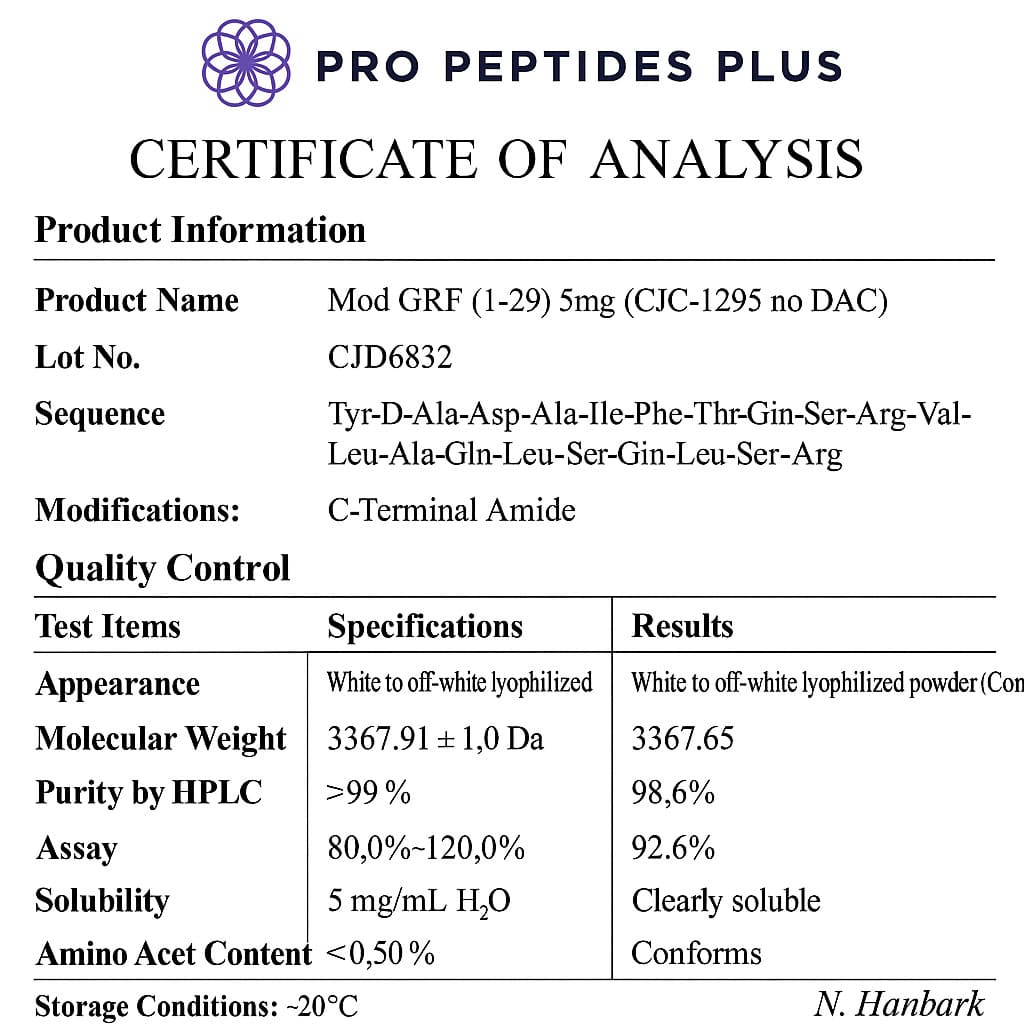

CJC-1295 (No DAC), also known as Mod GRF 1-29 — a research-grade GHRH analogue studied in growth hormone release models. ≥99% purity. Fast UK dispatch. Free delivery.
£34.99 Original price was: £34.99.£26.99Current price is: £26.99.
CJC-1295 (No DAC), also known as Mod GRF 1-29, is one of the most widely studied research peptides for supporting the body’s own growth hormone production.
In animal research, CJC-1295 (No DAC) has been studied for its role in:
CJC-1295 (No DAC) is most often researched alongside Ipamorelin — see the CJC-1295 & Ipamorelin bundle or the Ipamorelin 5mg page. For reconstitution, bacteriostatic water and syringes are available separately.
These products are supplied strictly for laboratory research and development purposes only. Not intended for human or animal consumption, diagnosis, treatment, or prevention of any disease.
CJC-1295 (No DAC), also known as Modified GRF (1-29), is a synthetic analogue of growth hormone-releasing hormone (GHRH). Endogenous GHRH is a 44-amino-acid signalling hormone; its first 29 amino acids (the fragment known as GRF 1-29, or Sermorelin) retain the full growth-hormone-releasing activity of the parent molecule. Modified GRF (1-29) takes that 29-amino-acid fragment and makes four amino acid substitutions (at positions 2, 8, 15 and 27) that resist enzymatic degradation and oxidation and increase binding affinity to the GHRH receptor — giving it greater stability and potency than unmodified GRF 1-29.
DAC stands for Drug Affinity Complex — an added linker that binds the peptide to albumin in the bloodstream, dramatically slowing its clearance. CJC-1295 with DAC carries this linker and has a half-life of roughly 6–8 days. CJC-1295 without DAC — this product — has no linker, so it is cleared quickly, with a half-life of approximately 30 minutes. Same core peptide; very different behaviour.
The difference is duration, and it changes how each form is used in research.
| Property | CJC-1295 No DAC (this product) | CJC-1295 with DAC |
|---|---|---|
| Half-life | ~30 minutes | ~6–8 days |
| GH release pattern | Short, pulsatile — mimics natural rhythm | Sustained, continuous elevation |
| Base peptide | Modified GRF (1-29) | Modified GRF (1-29) + albumin-binding linker |
| Studied alongside GHRPs (e.g. Ipamorelin) | Commonly — kinetically matched | Less commonly |
Because the No-DAC form produces a brief pulse rather than continuous elevation, it more closely reflects the body’s own GHRH rhythm — which is why it’s the version most often paired with a growth hormone secretagogue in dual-pathway research.
It binds the GHRH receptor on somatotroph cells in the anterior pituitary and activates the cAMP/PKA signalling pathway, stimulating the synthesis and release of growth hormone. Because it is short-acting, it produces a sharp, transient GH pulse and then clears — amplifying the natural pulse rather than flattening it into sustained elevation.
In preclinical and animal research, CJC-1295 and the GHRH pathway it acts on have been studied for a role in:
Much of the widely-cited CJC-1295 human data — such as the sustained GH and IGF-1 elevation reported by Teichman (2006), and the growth-normalisation work of Alba (2006) — was generated using the longer-acting DAC form. It is included in the Sources as reference literature for the CJC-1295 molecule, with the understanding that the No-DAC form studied here has the much shorter half-life described above.
CJC-1295 (No DAC) acts on the GHRH receptor, while Ipamorelin acts on a separate receptor (the ghrelin/GHSR-1a receptor). Activating both pathways at once has been shown in preclinical models to produce greater GH pulse amplitude than either compound alone, and because both are short-acting their kinetics match. This is why the two are the reference pairing in GH-axis research — available together as the CJC-1295 & Ipamorelin bundle.
Further reading: Should you mix CJC-1295 and Ipamorelin — and why No-DAC is the form used
Supplied as a lyophilised powder. Store sealed, protected from light and moisture; refrigerate after reconstitution.
Molecular Formula: C152H252N44O42
Molecular Weight: ~3367.9 g/mol
Structure

Synonyms
863288-34-0
CJC-1295
CID 56841945
L-tyrosyl-D-alanyl-L-alpha-aspartyl-L-alanyl-L-isoleucyl-L-phenylalanyl-L-threonyl-L-glutaminyl-L-seryl-L-tyrosyl-L-arginyl-L-lysyl-L-valyl-L-leucyl-L-alanyl-L-glutaminyl-L-leucyl-L-seryl-L-alanyl-L-arginyl-L-lysyl-L-leucyl-L-leucyl-L-glutaminyl-L-alpha-aspartyl-L-isoleucyl-L-leucyl-L-seryl-L-argininamide
446036-97-1
All articles and product information on this website are for educational purposes only. These products are not medicines or drugs and have not been approved to treat or cure any medical condition.


