TB-500 (thymosin-beta-4)

Sale -23%
TB-500 (thymosin-beta-4)

TB-500 (Thymosin Beta-4) research peptide. Studied in preclinical models for systemic recovery, cell migration and soft-tissue and muscle regeneration. ≥99% purity. Fast UK dispatch, free delivery.

concentration: 5mg

Original price was: £34.99.Current price is: £26.99.

-23%
For UK orders over £200
FREE Shipping
Free 10ml Bacteriostatic Water

TB-500 is a synthetic fragment of Thymosin Beta-4, a protein the body produces naturally. Unlike BPC-157, which acts locally, TB-500 is studied for its systemic, whole-body effects on recovery and tissue regeneration.

In preclinical animal research, TB-500 has been studied for its role in:

  • systemic (whole-body) recovery
  • cell migration and tissue regeneration
  • muscle and soft-tissue repair
  • angiogenesis (new blood-vessel formation)
  • reducing inflammation
  • flexibility and connective tissue

TB-500 is often researched alongside BPC-157 in recovery studies — the two are available together in the BPC-157 & TB-500 stack. Reconstitute with our bacteriostatic water and syringes.

For research use only. This product is intended strictly for laboratory research purposes and is not for human or animal consumption, medical use, or diagnostic use. Not a drug, food, or cosmetic.

What is TB-500?

TB-500 is a synthetic peptide based on a fragment of Thymosin Beta-4, a naturally occurring protein involved in tissue repair. In research it is studied for its systemic, body-wide effect on recovery — a contrast to the localised action of BPC-157.

What is TB-500 researched for?

In preclinical animal studies, TB-500 has been investigated for:

  • Cell migration — helping repair cells move to where they are needed (Goldstein; Malinda)
  • Muscle and soft-tissue regeneration — across multiple tissue types at once
  • Angiogenesis — the formation of new blood vessels
  • Inflammation — reducing systemic inflammation
  • Flexibility and connective tissue

What is the difference between TB-500 and Thymosin Beta-4?

Thymosin Beta-4 is the full naturally occurring protein; TB-500 is a shorter synthetic fragment that carries the active region responsible for much of the tissue-repair and cell-migration activity studied in research. The two names are often used interchangeably, but they are not identical.

How does TB-500 work?

TB-500’s active fragment binds actin, a protein central to cell structure and movement. In research this is linked to improved cell migration, new blood-vessel formation and tissue regeneration throughout the body, rather than at a single site.

Research summary

Research area (animal / preclinical) Reference
Cell migration & tissue regeneration Goldstein et al.; Malinda 1999
Angiogenesis Malinda 1997
Cardiac / tissue repair Bock-Marquette 2004
Mechanisms review Crockford et al.

Further reading: Why TB-500 and BPC-157 shouldn’t be pre-mixed

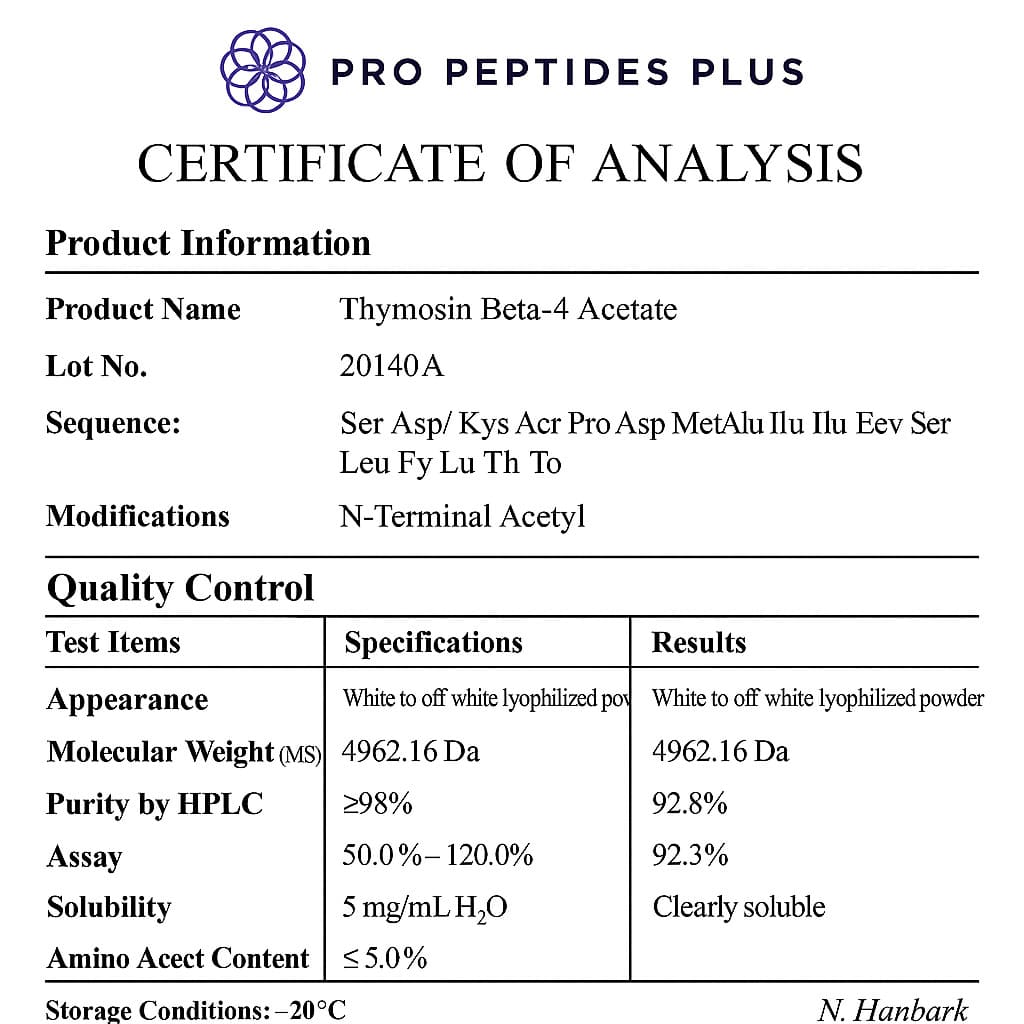
Molecular Formula: C212H350N56O78S
Molecular Weight: 4963.4 g/mol
View on PubChem

Structure

TB-500 peptide Structure

Synonyms
Thymosin Beta 4
77591-33-4
THYMOSIN BETA 4 ACETATE

([13C6]Leu17)-Thymosin b4 (human, bovine, horse, rat) trifluoroacetate salt Ac-Ser-Asp-Lys-Pro-Asp-Met-Ala-Glu-Ile-Glu-Lys-Phe-Asp-Lys-Ser-Lys-[13C6]Leu-Lys-Lys-Thr-Glu-Thr-Gln-Glu-Lys-Asn-Pro-Leu-Pro-Ser-Lys-Glu-Thr-Ile-Glu-Gln-Glu-Lys-Gln-Ala-Gly-Glu-Ser-OH trifluoroacetate salt
Thymosin b4 (cattle)

Selected Research References

  1. Goldstein AL, Hannappel E, Kleinman HK. Thymosin β4: actin-sequestering protein moonlights to repair injured tissues. Trends Mol Med. — PubMed
  2. Philp D, et al. The actin binding site on thymosin beta4 promotes angiogenesis. FASEB J. 2003. — PubMed
  3. Malinda KM, et al. Thymosin beta4 promotes angiogenesis, wound healing, and hair follicle development.PubMed
  4. Kleinman HK, Sosne G. Thymosin β4 Promotes Dermal Healing. 2016. — PubMed
  5. Smart N, et al. Thymosin beta4 and angiogenesis: modes of action and therapeutic potential. Angiogenesis. 2007. — PubMed
  6. Tokura Y, et al. Muscle injury-induced thymosin β4 acts as a chemoattractant for myoblasts. 2011. — PubMed
  7. Song Z, Han A, Hu B. Thymosin β4 promotes zebrafish Mauthner axon regeneration via actin polymerisation. BMC Biol. 2024. — PubMed
  8. Maar K, et al. Thymosin Beta-4 Modulates Cardiac Remodelling by Regulating ROCK1 Expression in Adult Mammals. Int J Mol Sci. 2025. — PubMed
0
    0
    Your Cart
    Your cart is emptyReturn to Shop