
The Wolverine Stack: Why You Shouldn’t Mix BPC-157 and TB-500
Quick answer
Can BPC-157 and TB-500 be used together? Yes — it is the most common pairing in tissue-repair research, and the rationale is sound: BPC-157 acts locally at an injury site, TB-500 acts systemically across the body. Their mechanisms are complementary rather than redundant.
But two things are worth knowing. First, no published study has ever tested the combination — every piece of evidence behind the stack comes from research on one compound or the other, never both. Second, the two have very different half-lives, which is why they are not well suited to being pre-mixed in a single vial.
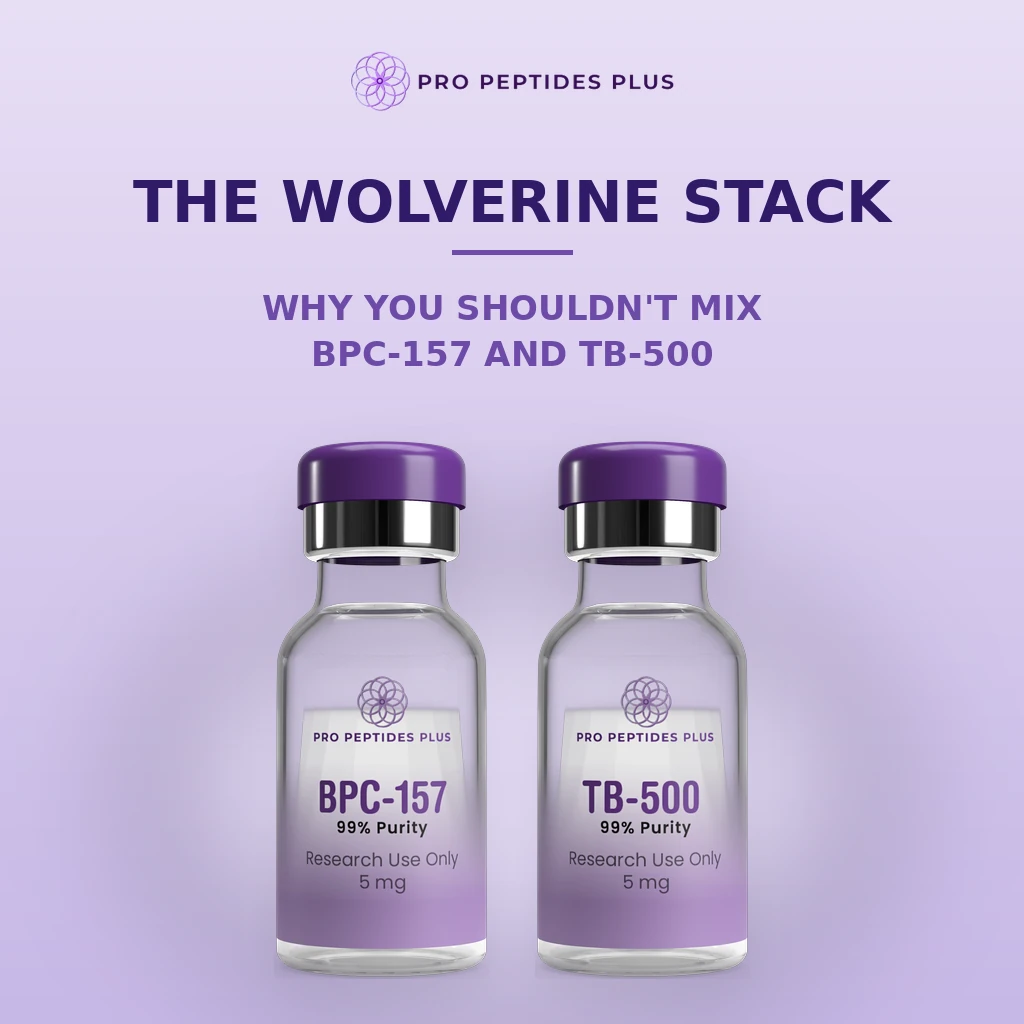
The “Wolverine stack” is the informal name for combining BPC-157 and TB-500 — a nod to the comic-book character’s regenerative healing. It is the most frequently discussed peptide combination in recovery research, and the two are widely sold together, including as pre-mixed blends.
This article looks at what the research actually supports, where the reasoning is extrapolation rather than evidence, and why the format the two are supplied in genuinely matters.
What each compound contributes
The reason the pairing is coherent — rather than two similar things sold together — is that BPC-157 and TB-500 operate on different scales of tissue repair.
| BPC-157 | TB-500 | |
|---|---|---|
| Origin | Synthetic 15-amino-acid peptide, derived from a protein found in gastric juice | Synthetic fragment of Thymosin Beta-4, a naturally occurring protein |
| Scale of action | Localised — studied at the site of injury | Systemic — studied across multiple tissues at once |
| Studied for | Angiogenesis, collagen, growth-factor signalling, tendon and ligament repair, gut lining | Cell migration, soft-tissue and muscle regeneration, angiogenesis, inflammation |
| Proposed mechanism | Growth-factor and angiogenic signalling; recruitment of fibroblasts | Actin binding; mobilising repair cells to move through tissue |
A useful way to think about it: in the research literature, BPC-157 is associated with building the supply lines — new blood vessels and connective tissue at a specific site — while Thymosin Beta-4 is associated with getting repair cells to move to where they are needed and remodel the tissue. Those are different jobs.
For the depth on BPC-157’s localised action, see our guide to BPC-157 and tendon repair.
Why BPC-157 and TB-500 run on different schedules
This is the part most discussions skip, and it is the most practically important thing about the pairing.
The two compounds have very different half-lives. BPC-157 clears quickly — its activity is generally described in terms of hours. TB-500 persists substantially longer, with its activity described in terms of days. Because of that difference, research protocols schedule them differently: BPC-157 features far more frequently, while TB-500 appears on a much less frequent schedule, often with an initial higher-frequency phase followed by a lower-frequency one.
The quantities differ too. The amounts of TB-500 referenced in the literature are roughly an order of magnitude larger than those referenced for BPC-157 — a difference of scale, not a rounding error.
| BPC-157 | TB-500 | |
|---|---|---|
| Half-life | Short — described in hours | Long — described in days |
| Frequency in protocols | Frequent | Infrequent; often a two-phase structure |
| Relative quantity | Smaller by roughly an order of magnitude | Larger by roughly an order of magnitude |
| Where it acts | At the site | Throughout the body |
An honest caveat: there is no robust published human pharmacokinetic data for either compound. The half-life figures circulating online vary considerably from source to source — for TB-500 alone, published estimates range from around a day to over a week. What is not in dispute is the direction of the difference: BPC-157 is short-acting, and TB-500 is long-acting. That difference is what matters here.
Can BPC-157 and TB-500 be mixed in one vial?
They can be bought pre-mixed — but there are good reasons not to.
A pre-blended vial fixes two things permanently: the ratio between the two peptides, and the schedule on which both are used. Given what we have just covered, that is a real constraint:
- One schedule cannot suit both. Use the blend frequently enough to match BPC-157’s short half-life, and you are necessarily using far more TB-500 than its own protocols reference. Use it on TB-500’s slower schedule, and BPC-157 has cleared for most of the interval.
- The two-phase structure disappears. TB-500’s typical protocol structure — a higher-frequency initial phase followed by a lower-frequency one — cannot be run from a fixed blend. Pre-blended protocols simply omit it.
- The ratio is locked. Separate vials allow each compound to be prepared, adjusted, tapered or stopped independently.
- There is no published stability data for the two peptides held together in a single solution. Keeping them separate removes that unknown entirely.
None of this makes a blend useless. It makes it a convenience trade-off — one vial and one injection, at the cost of any independent control over either compound. Supplying the two as separate vials is the format that respects both compounds’ kinetics.
Has the combination actually been studied?
No. As of 2026, there is no published peer-reviewed study testing BPC-157 and TB-500 together — not in humans, not in animals, not in cells.
This is worth stating plainly, because a great deal of writing about the Wolverine stack implies otherwise. The individual evidence is real: BPC-157 has replicated animal data, particularly in rat tendon models, and Thymosin Beta-4 has a substantial body of wound-healing research behind it. But every citation offered in support of the stack is a study of one compound alone.
The synergy argument is therefore mechanistic extrapolation — reasoning from what each does separately to what they might do together. That reasoning is coherent. It is not the same as evidence.
There is also a reason the combination is difficult to test cleanly: because both compounds act on overlapping repair pathways (angiogenesis, cell migration), a study of the two together struggles to attribute any observed effect to either one. The confounding is built in.
Do they genuinely work better together?
Both sides of this deserve a fair hearing.
The case for combining
- The mechanisms are genuinely complementary. Different molecular targets, different scales — this is not two versions of the same thing.
- Together they cover more of the repair cascade — local rebuilding on one side, cell mobilisation and remodelling on the other.
- No adverse interaction between the two is documented in the research literature.
- It is the default pairing in recovery research — the reasoning behind it is considered, not arbitrary.
The case for caution
- The combination is untested. Every supporting citation is single-compound.
- Confounded pathways. If something works — or doesn’t — the design makes it hard to say which compound was responsible.
- Shared theoretical risks are not diluted by combining. The literature raises theoretical concerns about compounds that promote angiogenesis and cell migration; both of these do, so pairing them does not offset that concern.
- Layered extrapolation. TB-500 is a fragment of Thymosin Beta-4, and much of the human evidence cited for it is drawn from research on the full-length parent protein — a second inferential step on top of the first.
The honest summary: the pairing is plausible and popular, not proven. Anyone telling you the Wolverine stack is clinically demonstrated is going beyond what the literature supports.
Regulatory and sporting status
Both compounds are prohibited by the World Anti-Doping Agency. Neither is approved by the FDA for any indication. In April 2026 the FDA removed BPC-157 — along with a number of other peptides, TB-500 among them — from the Section 503A Category 2 list that had restricted compounding, and a Pharmacy Compounding Advisory Committee meeting on 23–24 July 2026 is due to consider them further. Both remain investigational.
Frequently asked questions
What is the Wolverine stack?
The informal name for combining BPC-157 and TB-500, two peptides studied for tissue repair. The name refers to the comic-book character’s regenerative healing.
Can BPC-157 and TB-500 be mixed in the same vial?
They are sold pre-mixed, but there are good reasons to keep them separate: their half-lives and the quantities used differ substantially, so a fixed blend forces one schedule and one ratio onto two compounds that suit different ones. There is also no published stability data for the two held in a single solution.
Has the BPC-157 and TB-500 combination been studied?
No. As of 2026 no published peer-reviewed study has tested the two together in any model. The evidence behind the stack is drawn entirely from research on each compound individually.
Why are BPC-157 and TB-500 used on different schedules?
Because BPC-157 is short-acting, described in terms of hours, while TB-500 is long-acting, described in terms of days. That difference in half-life is why research protocols reference them at very different frequencies.
Do BPC-157 and TB-500 work better together?
Their mechanisms are complementary and the reasoning is coherent, but the combination has never been directly tested. The rationale is mechanistic extrapolation, not demonstrated synergy.
Is the Wolverine stack banned in sport?
Yes. Both BPC-157 and TB-500 are prohibited by the World Anti-Doping Agency.
Where this leaves the stack
BPC-157 and TB-500 are the two most-researched tissue-repair peptides, and the reason they are paired is a real one: they do different things, at different scales, through different mechanisms. That is a far better reason to combine two compounds than the fact that they are sold in the same box.
What the evidence does not support is the idea that the combination itself has been tested. It has not. And the practical consequence of their different kinetics is that a single pre-mixed vial cannot serve both compounds well — which is why we supply them as two separate vials, alongside the individual BPC-157 and TB-500 pages.
For research use only. The compounds discussed here are supplied strictly for laboratory research purposes and are not for human or animal consumption, medical use, or diagnostic use. This article describes published laboratory and animal research and is not a protocol, a recommendation, or medical advice.
References
- Chang C-H, Tsai W-C, Lin M-S, Hsu Y-H, Pang J-HS. The promoting effect of pentadecapeptide BPC 157 on tendon healing involves tendon outgrowth, cell survival, and cell migration. J Appl Physiol. 2011;110(3):774–780. PMID: 21148156. View on PubMed
- Staresinic M, Petrovic I, Novinscak T, et al. Effective therapy of transected quadriceps muscle in rat: gastric pentadecapeptide BPC 157. J Orthop Res. 2006;24(5):1109–1117. PMID: 16583441. View on PubMed
- Sikiric P, Seiwerth S, Rucman R, et al. Stable gastric pentadecapeptide BPC 157: novel therapy in gastrointestinal tract. Curr Pharm Des. 2011;17(16):1612–1632. PMID: 21548867. View on PubMed
- Goldstein AL, Hannappel E, Kleinman HK. Thymosin β4: actin-sequestering protein moonlights to repair injured tissues. Trends Mol Med. 2005;11(9):421–429. PMID: 16099219. View on PubMed
- Malinda KM, Sidhu GS, Mani H, et al. Thymosin β4 accelerates wound healing. J Invest Dermatol. 1999;113(3):364–368. View study
- Crockford D. Development of thymosin β4 for treatment of patients with ischemic heart disease. Ann N Y Acad Sci. 2007;1112:385–395. PMID: 17468262. View on PubMed
- Yuan et al. BPC-157 research review. 2026. doi:10.3390/ijms27062876
- Note: every reference above is a study of a single compound. No published study of the BPC-157 and TB-500 combination exists.
Further reading: BPC-157 for Tendon & Tissue Repair: What the Research Shows