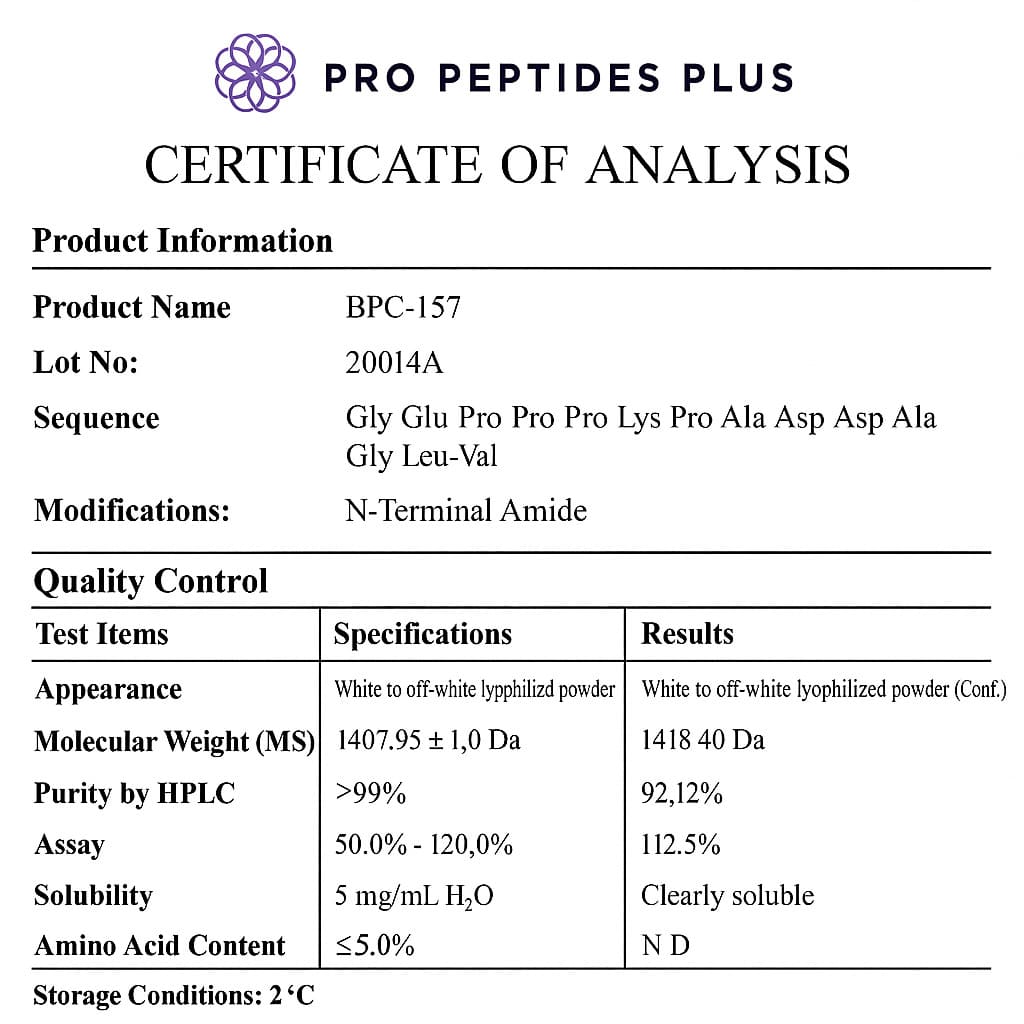
BPC-157 research peptide. Studied in preclinical models for tendon, ligament and tissue repair, angiogenesis and gut-lining protection. ≥99% purity. Fast UK dispatch, free delivery.
£19.99 Original price was: £19.99.£15.99Current price is: £15.99.
BPC-157 (Body Protection Compound 157) is a synthetic 15-amino-acid research peptide derived from a protein found in gastric juice. It is one of the most-studied peptides in tissue-repair research, known for acting locally at the site of injury.
In preclinical animal research, BPC-157 has been studied for its role in:
For a closer look at the tendon research, see our guide on BPC-157 and tendon repair.
BPC-157 is often researched alongside TB-500 in recovery studies — the two are available together in the BPC-157 & TB-500 stack. Reconstitute with our bacteriostatic water and syringes.
For research use only. This product is intended strictly for laboratory research purposes and is not for human or animal consumption, medical use, or diagnostic use. Not a drug, food, or cosmetic.
BPC-157 (Body Protection Compound 157) is a synthetic peptide made of 15 amino acids, derived from a protective protein found in gastric juice. In research, it is studied mainly for tissue repair, and it is known for acting locally at the site of injury rather than systemically.
In preclinical animal studies, BPC-157 has been investigated for:
For the tendon research in depth, see our BPC-157 and tendon repair guide.
Yes. Because BPC-157 is derived from a compound found in gastric juice, much of the early research examined its protective effect on the stomach and intestinal lining in animal models. This gastrointestinal research is part of what distinguishes it from systemic recovery peptides.
In research, BPC-157 is thought to act mainly at the site of injury. It has been studied for promoting angiogenesis (new blood vessels), recruiting fibroblasts (the cells that rebuild connective tissue), and modulating growth-factor and nitric-oxide pathways — together supporting local tissue repair.
| Research area (animal / preclinical) | Reference |
|---|---|
| Tendon & ligament repair | Chang 2011; Krivic 2006 |
| Angiogenesis / blood-vessel formation | Sikirić et al. |
| Gut lining & cytoprotection | Sikirić et al. |
| Recent research review | Yuan 2026 |
Further reading: Why BPC-157 and TB-500 shouldn’t be mixed
Structure

Yuan, C., et al. From Regeneration to Analgesia: The Role of BPC-157 in Tissue Repair and Pain Management. Int J Mol Sci. 2026;27:2876. https://doi.org/10.3390/ijms27062876
Chang, C. H., Tsai, W. C., Lin, M. S., Hsu, Y. H., & Pang, J. H. S. (2011). The promoting effect of pentadecapeptide BPC 157 on tendon healing involves tendon outgrowth, cell survival, and cell migration. Journal of Applied Physiology, 110(3), 774-780. https://pubmed.ncbi.nlm.nih.gov/21148336/
Brcic, L., Brcic, I., Staresinic, M., Novinscak, T., Sikiric, P., & Seiwerth, S. (2009). Modulatory effect of gastric pentadecapeptide BPC 157 on angiogenesis in muscle and tendon healing. J Physiol Pharmacol, 60(Suppl 7), 191-96. https://pubmed.ncbi.nlm.nih.gov/20400799/
Krivic, A., Majerovic, M., Jelic, I., Seiwerth, S., & Sikiric, P. (2008). Modulation of early functional recovery of Achilles tendon to bone unit after transection by BPC 157 and methylprednisolone. Inflammation Research, 57(5), 205-210. https://pubmed.ncbi.nlm.nih.gov/17943447/
Keremi, B., Lohinai, Z., Komora, P., Duhaj, S., Borsi, K., Jobbagy-Ovari, G., & Varga, G. (2009). Anti-inflammatory effect of BPC 157 on experimental periodontitis in rats. J Physiol Pharmacol, 60(Suppl 7), 115-22. https://pubmed.ncbi.nlm.nih.gov/20400806/
Seiwerth, S., Sikiric, P., Grabarevic, Z., Zoricic, I., Hanzevacki, M., Ljubanovic, D., & Kolega, Z. (1997). BPC 157’s effect on healing. Journal of Physiology-Paris, 91(3), 173-178. https://pubmed.ncbi.nlm.nih.gov/9364944/
Sikiric, P., Seiwerth, S., Grabarevic, Z., Petek, M., Rucman, R., Turkovic, B., & Brkic, T. (1994). The beneficial effect of BPC 157, a 15 amino acid peptide BPC fragment, on gastric and duodenal lesions. Life Sciences, 54(5), PL63-PL68. https://pubmed.ncbi.nlm.nih.gov/8164685/
Sikiric, P., Marovic, A., Matoz, W., Anic, T., Buljat, G., Mikus, D., & Hahn, V. (1999). A behavioural study of the effect of pentadecapeptide BPC 157 in Parkinson’s disease models in mice. Journal of Physiology-Paris, 93(6), 505-512. https://pubmed.ncbi.nlm.nih.gov/10701049/