
BPC-157 for Tendon & Tissue Repair: What the Research Shows

Quick answer: BPC-157 (Body Protection Compound-157) is a synthetic 15-amino-acid peptide studied for its role in tendon and soft-tissue repair research. The preclinical evidence comes mainly from rodent models, where BPC-157 has been associated with faster healing of transacted Achilles tendon and ligament injuries. Researchers attribute this to three mechanisms studied in animals: the growth of new blood vessels (angiogenesis, via VEGFR2), the movement of repair cells to the injury (fibroblast migration, via the FAK-paxillin pathway), and effects on blood flow through the nitric-oxide pathway. There are no completed Phase 2 or Phase 3 human trials. BPC-157 is a research-use-only compound and is not approved for human use.
Why Tendons Are So Hard to Heal
Tendons and ligaments are slow to recover for one structural reason: they are largely avascular, meaning they receive very little blood supply compared with muscle. Muscle tissue is rich in blood vessels, so oxygen, nutrients and repair cells reach an injury quickly. Tendons are not — which is why a torn Achilles or a chronic elbow tendinopathy can nag for months.
This is the exact problem that makes BPC-157 interesting to researchers. The peptide is studied primarily for its role in helping new blood vessels grow (a process called angiogenesis), which is the rate-limiting step in repairing poorly vascularised tissue. That mechanistic fit between a peptide that supports new blood-vessel growth and a tissue starved of blood supply is the reason BPC-157 appears so often in tendon and ligament research, rather than in studies of well-supplied tissue.
What Is BPC-157?
BPC-157 is a synthetic peptide made up of 15 amino acids (sequence GEPPPGKPADDAGLV), with a molecular weight of approximately 1,419 g/mol. It is a partial sequence of a larger protein called Body Protection Compound, which was originally isolated from human gastric juice. Although it was first investigated for protective effects in the digestive tract, later research turned to its apparent activity in tendon, ligament, muscle and bone repair models.
For the full specification, purity data and structure, see the BPC-157 5mg research peptide product page.
BPC-157 Tendon Repair: The Three Phases of Healing
Tendon healing follows three overlapping biological phases. What makes BPC-157 tendon repair research unusual in the research literature is that it has been studied across all three, rather than at a single point. The table below maps each phase to the mechanism researchers have examined. 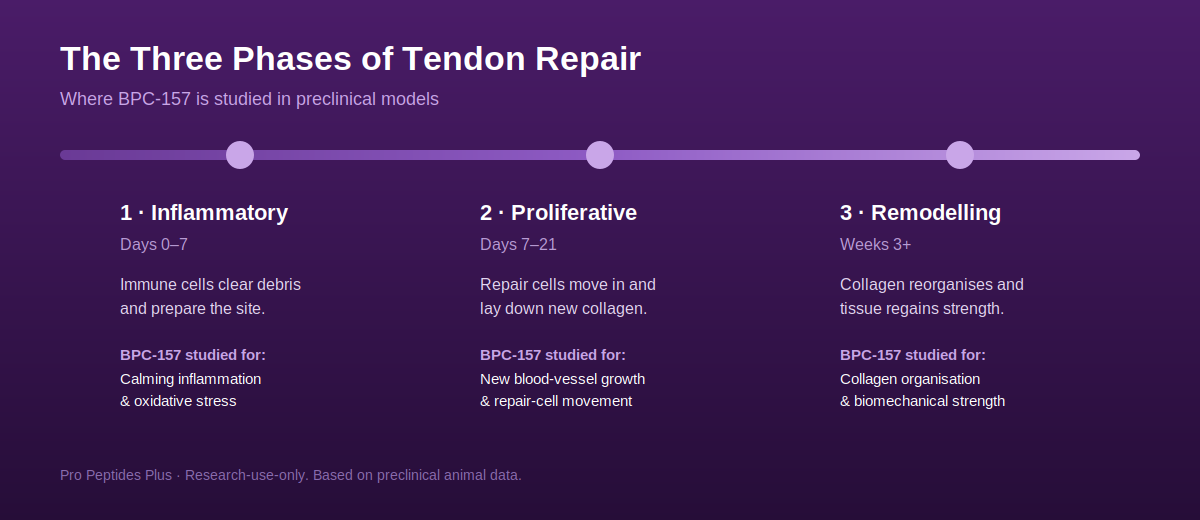
| Repair phase | Approximate timing | What happens biologically | BPC-157 mechanism studied in animal models |
|---|---|---|---|
| Inflammatory | Days 0–7 | Immune cells clear debris; the injury site is prepared for rebuilding | Modulation of inflammatory response; reduced oxidative stress |
| Proliferative | Days 7–21 | Repair cells move in and lay down new collagen matrix | Repair-cell movement (fibroblast migration via FAK-paxillin); new blood-vessel growth (angiogenesis via VEGFR2) |
| Remodelling | Weeks 3 onward | Collagen reorganises and the tissue regains strength | Collagen organisation and biomechanical strength observed in rodent studies |
The Key Mechanisms, Explained Simply
Across the preclinical literature, three mechanistic themes come up repeatedly. None of these are claims about effects in people — they describe what has been observed in laboratory and animal research. 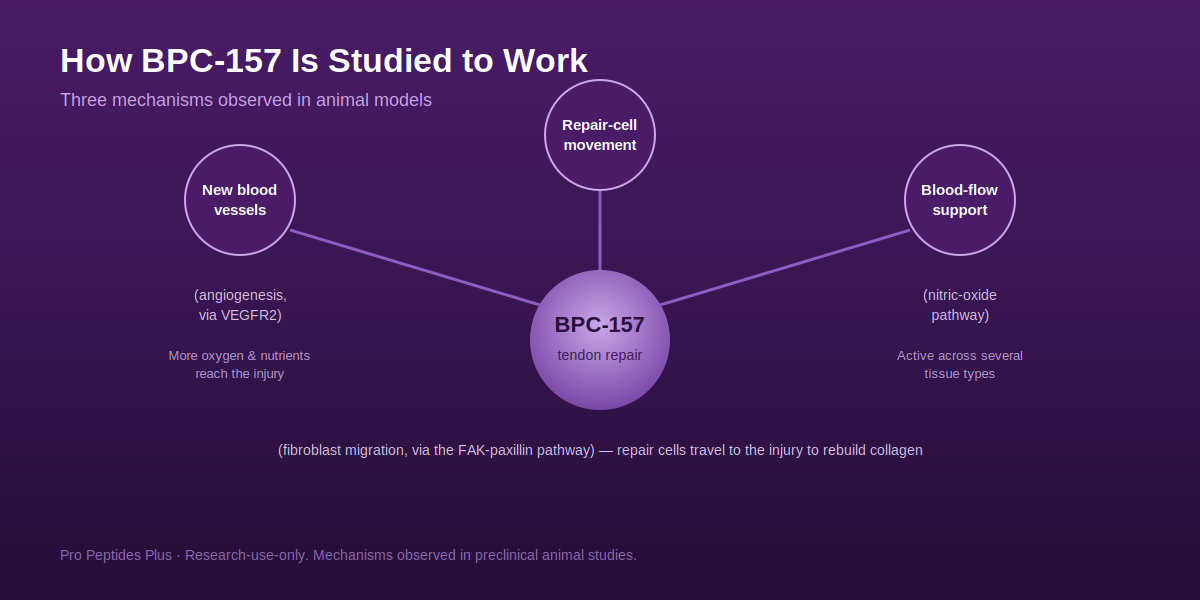
1. Growing new blood vessels (angiogenesis)
Multiple rodent studies report that BPC-157 boosts a signal called vascular endothelial growth factor receptor 2 (VEGFR2) and is linked to new blood-vessel growth into damaged tissue. For a tissue starved of blood supply like tendon, more blood vessels means more oxygen, nutrients and repair cells reaching the injury — which is why this mechanism receives the most research attention.
2. Moving repair cells to the injury (fibroblast migration)
Fibroblasts are the cells that build new collagen, the material tendons are made of. For them to do their job, they have to physically travel to the injury site. In laboratory work using tendon cells, BPC-157 has been observed to influence the FAK-paxillin pathway, which controls how these cells grip and move. Chang and colleagues (2011) reported that BPC-157 sped up the outgrowth and movement of tendon repair cells in a dose-dependent way.
3. Supporting blood flow (nitric-oxide pathway)
BPC-157 has also been studied for its effect on the nitric-oxide (NO) pathway, which helps regulate blood flow and the body’s protective response to tissue stress. This is one proposed reason the compound shows activity across several different tissue types in animal models, rather than acting on tendon alone.
The Foundational Research Studies
The table below summarises the most frequently cited preclinical studies in BPC-157 tendon and soft-tissue research. All are animal or in-vitro studies unless otherwise stated.
| Study | Model | What was observed |
|---|---|---|
| Staresinic et al. (2003), J Orthop Res | Transected rat Achilles tendon | Improved biomechanical strength (load to failure), functional recovery, collagen formation and reduced defect size vs. controls |
| Chang et al. (2011), J Appl Physiol | Rat tendon fibroblasts (in vitro) | Accelerated fibroblast outgrowth and migration via FAK-paxillin pathway; improved cell survival under oxidative stress |
| Krivic et al. (2006), J Orthop Res | Rat Achilles tendon-to-bone detachment | Promoted tendon-to-bone healing; opposed corticosteroid-impaired healing |
| Vasireddi et al. (2025), HSS Journal (systematic review) | Review of 36 studies (35 preclinical, 1 clinical) | Across models, BPC-157 associated with improved functional, structural and biomechanical outcomes in muscle, tendon, ligament and bone injuries |
What the Evidence Does — and Doesn’t — Show
This is where honesty matters, and where research-grade sources separate themselves from marketing. The body of preclinical animal data for BPC-157 in soft-tissue repair is substantial and consistent. The human data is not.
As of 2026, only a handful of small pilot studies have examined BPC-157 in humans, and there are no completed Phase 2 or Phase 3 clinical trials. A 2025 systematic review (Vasireddi et al.) and a 2025 narrative review both concluded that while the regenerative signal in animals is compelling, robust human clinical evidence is lacking. Any researcher working with this compound should treat the animal-to-human gap as the central open question.
Regulatory and Sporting Status
BPC-157 is not approved by the FDA or MHRA for human use. It is also prohibited in competitive sport: it appears on the World Anti-Doping Agency (WADA) prohibited list, and organisations including the NFL, UFC and NCAA have banned it. In the United States, the FDA’s Pharmacy Compounding Advisory Committee is scheduled to review BPC-157 in 2026. For these reasons, BPC-157 is supplied strictly as a research-use-only reference compound.
BPC-157 and TB-500 in Combination Research
In recovery research, BPC-157 is frequently studied alongside TB-500 (Thymosin Beta-4). The two are investigated together because they are studied for complementary mechanisms — BPC-157 for moving repair cells and growing new blood vessels at the injury site, and TB-500 for actin regulation and broader cell movement throughout the tissue. This pairing, sometimes referred to in research circles as the “wolverine stack,” is available as the BPC-157 & TB-500 research bundle.
Notes for UK Researchers
For laboratory research in the UK, the practical considerations are purity, documentation and correct handling. Reference-grade material should be HPLC-verified, supplied as a lyophilised powder, and reconstituted with bacteriostatic water using sterile syringes. Pro Peptides Plus supplies BPC-157 at ≥99% purity with UK dispatch; see the product page for current specification.
Frequently Asked Questions
What is BPC-157 used for in research?
BPC-157 is studied in preclinical research for its role in tendon, ligament and soft-tissue repair, primarily through mechanisms involving angiogenesis and fibroblast migration. It is a research-use-only compound and is not approved for human use.
Does BPC-157 work for tendon repair?
In rodent models, BPC-157 has been associated with accelerated healing of transected Achilles tendon and ligament injuries. However, there are no completed human clinical trials, so its effects in people have not been established.
How does BPC-157 work?
The mechanisms studied in animal models include growing new blood vessels (angiogenesis, via VEGFR2), helping repair cells move to the injury (fibroblast migration, via the FAK-paxillin pathway), and supporting blood flow through the nitric-oxide pathway.
Is BPC-157 legal in the UK?
BPC-157 can be supplied in the UK as a research-use-only reference compound. It is not approved as a medicine for human use, and it is banned in competitive sport by WADA and other bodies.
What is the difference between BPC-157 and TB-500?
Both are studied for tissue repair, but through different mechanisms. BPC-157 is most associated with new blood-vessel growth and repair-cell signalling at the injury site, while TB-500 (Thymosin Beta-4) works mainly through actin regulation and broader cell movement. They are often studied together.
References
- Staresinic M, et al. Gastric pentadecapeptide BPC 157 accelerates healing of transected rat Achilles tendon and in vitro stimulates tendocytes growth. J Orthop Res. 2003. — DOI
- Chang CH, et al. The promoting effect of pentadecapeptide BPC 157 on tendon healing involves tendon outgrowth, cell survival, and cell migration. J Appl Physiol. 2011. — PubMed
- Krivic A, et al. Achilles detachment in rat and stable gastric pentadecapeptide BPC 157: promoted tendon-to-bone healing and opposed corticosteroid aggravation. J Orthop Res. 2006. — DOI
- Vasireddi N, et al. Emerging Use of BPC-157 in Orthopaedic Sports Medicine: A Systematic Review. HSS Journal. 2025. — Journal
- McGuire FP, et al. Regeneration or Risk? A Narrative Review of BPC-157 for Musculoskeletal Healing. Curr Rev Musculoskelet Med. 2025. — PubMed
This article is provided for educational and informational purposes only. The peptides discussed are supplied strictly for laboratory research and development purposes and are not approved for human or animal consumption, diagnosis, treatment, or prevention of any disease. Author: Pro Peptides Plus Research Team.